Choosing a men’s shirt is not just about finding the right size or color. The design, pattern, and texture of the fabric transform a plain piece into a true style marker. One must know how to read the details that differentiate a successful original shirt from a flashy print that becomes tiresome after two wears.
Fabric and collar: the two technical details that change everything
Before even discussing patterns, the material determines the visual appeal of a shirt. A twisted cotton, whose thread is twisted several times before weaving, provides a more durable fabric and a subtle sheen that basic cotton does not produce. It is this type of fiber that allows prints to remain sharp wash after wash.
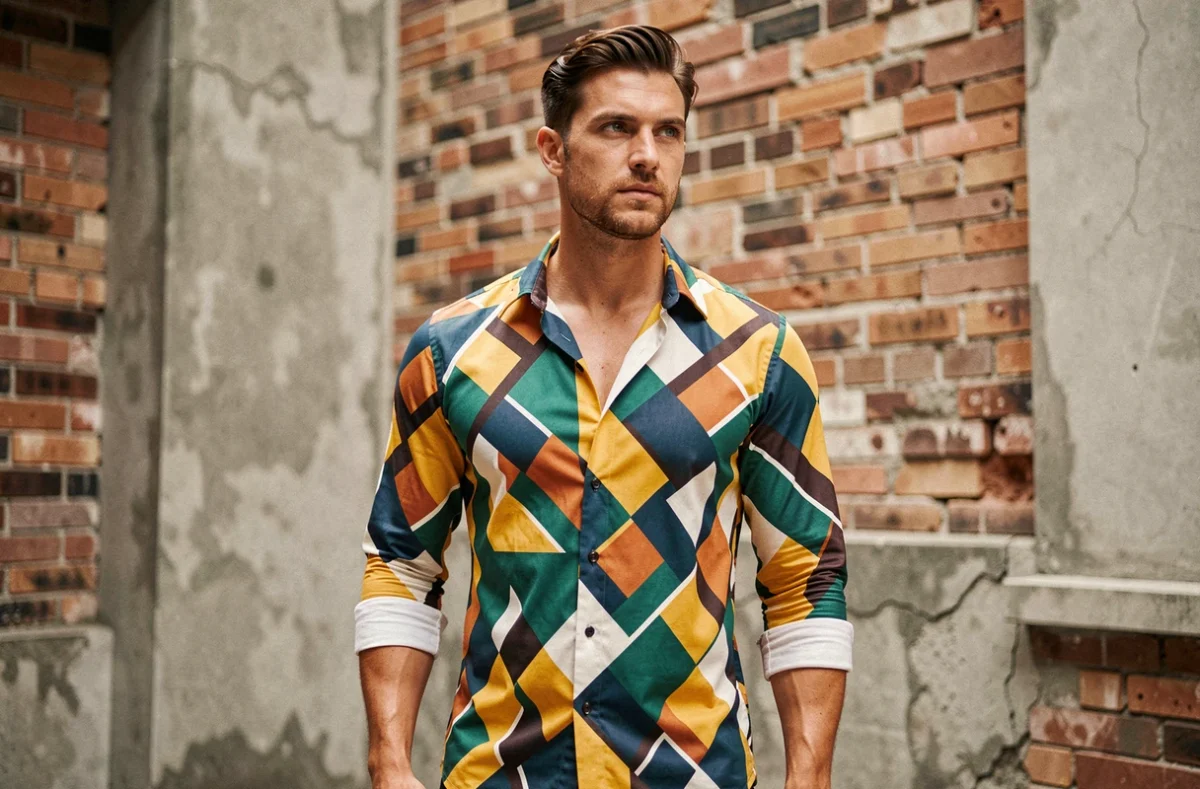
The collar frames the face. An open Italian collar highlights a floral or geometric pattern worn without a tie. A more discreet button-down collar suits busy designs by providing a sober anchor. The collar structures the gaze as much as the pattern of the shirt.
Have you ever noticed that the same print looks dull on one shirt and vibrant on another? The density of the weave often explains this difference. Fabrics with twill or oxford weaves capture light differently than smooth poplin, altering the perception of printed colors.
Among the men’s shirts with original designs, those that stand the test of time combine quality cotton with a collar construction suited to the style of the pattern. This technical duo often goes unnoticed, but it is what separates a satisfying purchase from a disappointment after a few weeks.

Original patterns for men’s shirts: beyond stripes and gingham
Stripes and gingham remain safe bets. The problem is that they assert nothing. To stand out, three families of patterns deserve your attention.
Micro-geometric prints
Diamonds, hexagons, honeycomb patterns: these designs play on small-scale repetition. From a distance, the shirt appears solid. Up close, the pattern emerges. A micro-pattern adds character without shouting. It is the most versatile choice for a professional context where the dress code remains flexible.
Floral or botanical patterns
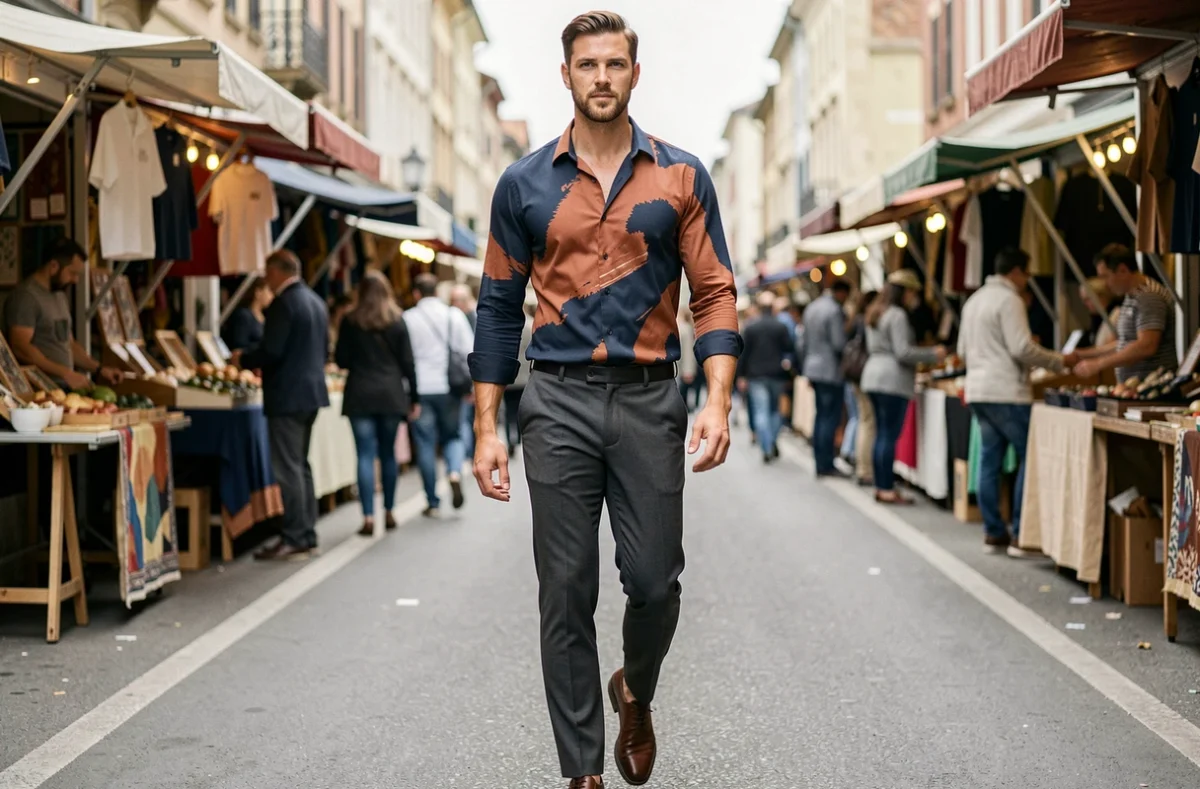
Masculine florals have long suffered from an overly fanciful image. Current versions favor muted tones (khaki, burgundy, navy) on a dark background. The result works well with both chinos and raw denim.
Jacquards and woven textures
Here, originality does not come from a print but from the fabric itself. The pattern is integrated into the weave, creating a subtle relief. A tone-on-tone jacquard advantageously replaces a solid shirt for those who want subtlety without a visible print.
- Micro-geometric patterns are suitable for the office and semi-formal contexts, worn with dress pants or chinos.
- Florals on a dark background work well for evenings or weekends, paired with jeans and boots.
- Tone-on-tone jacquards fit anywhere, including under a blazer, thanks to their visual discretion.
Fit and comfort: an original shirt that doesn’t fit is useless
A remarkable pattern loses all its effect if the fit pulls at the shoulders or gapes at the collar. Two measurements are enough to avoid mistakes: the collar size and sleeve length.
The collar size is measured with a tape measure wrapped around the neck, adding about a finger’s worth of ease. The sleeve length is taken from the middle of the back to the wrist, with the arm slightly bent. These two markers eliminate most unpleasant surprises when shopping online.
Why insist on fit when discussing original design? Because a complex pattern amplifies every fitting flaw. Unsightly folds on a geometric print fabric disrupt the pattern’s repetition and create a messy effect. On a solid shirt, the same flaw goes almost unnoticed.
Comfort also depends on ironing. Twisted cotton shirts wrinkle less than classic poplin, but no natural fiber completely eliminates creases. So-called “easy care” treatments reduce maintenance without resorting to synthetics. Prefer a treated natural cotton over a polyester blend if you want to maintain the breathability of the fabric.
Textile traceability: an emerging criterion for original shirts
European regulations are pushing brands towards greater transparency. Since July 19, 2026, large companies can no longer destroy unsold clothing in the European Union, except for exceptions provided by delegated regulation (EU) 2026/296. This ban favors small series and original designs produced in reasonable quantities.
At the same time, a digital passport for textile products is in preparation. It should make accessible the composition, origin, and possibilities for reuse or recycling. The exact timeline will depend on the delegated act and its transition period, but the direction is clear.
For consumers looking for a shirt with a unique design, this evolution has a concrete effect: brands that produce in small series gain a regulatory advantage over those that rely on overproduction of seasonal models. Choosing an original shirt increasingly means choosing a model whose production is traceable.
- Check the exact composition on the label: a twisted cotton or certified fabric offers more guarantees than a vague mention of “premium cotton.”
- Look for brands that communicate about their production location and the number of pieces produced per model.
- Keep an eye on the arrival of the digital passport, which will simplify comparisons between shirts based on objective criteria.
An original men’s shirt is not just about a pretty pattern. The fabric, collar, fit, and now traceability form a coherent whole. The pattern catches the eye, but it is these technical criteria that determine whether the piece remains in your rotation or ends up forgotten at the back of the closet.