
An engine covered in oil poses more than just an aesthetic problem. Greasy projections trap dust and heat, accelerate the aging of hoses and seals, and obscure the exact source of a leak. Before choosing a product to clean an oil-soiled engine, one must understand what they aim to achieve: a clean compartment, a reliable leak diagnosis, or an internal circuit free of sludge before draining.
External cleaning or internal rinsing: two problems, two chemistries
Confusion often arises in forums and product sheets. An engine compartment degreaser and a pre-drain cleaner do not serve the same function at all, and mixing them in the same reasoning leads to poor choices.
The external degreaser is a product sprayed onto the visible surfaces of the compartment: oil pan, engine block, hoses, connectors. It acts on the grease, grime, and oil residues that have accumulated over the miles. Its formula is designed not to attack rubber or plastics, and it can be rinsed with low-pressure water or wiped with a cloth.
The pre-drain cleaner is poured directly into the lubrication circuit through the oil filler cap. It dissolves the sludge and internal deposits accumulated in the channels, around the rings, and in the oil pan. According to Bardahl’s instructions, this type of product works for about twenty minutes before draining, then is evacuated with the used oil.
Choosing an oil engine cleaning product therefore first requires knowing whether the contamination is external, internal, or both.
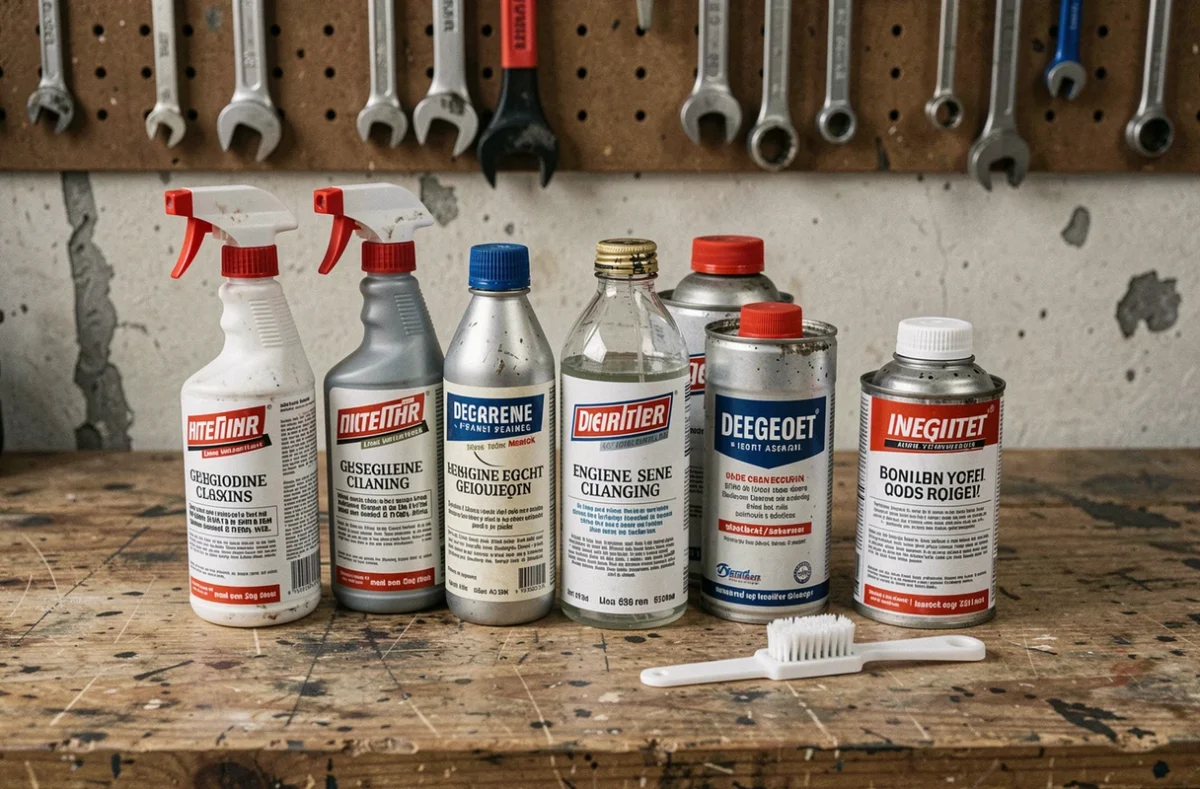
Aerosol or liquid engine degreaser: concrete selection criteria
For external cleaning, the market offers ready-to-use aerosols and concentrated degreaser cans to dilute. The choice between the two depends less on raw efficiency than on the method of application and the type of dirt.
Viscosity and contact time on oil deposits
A viscous liquid product adheres better to the vertical walls of the engine block. On old contamination, where the oil has cooked and formed a dark crust, this prolonged contact time makes a difference. Aerosols, being more fluid, are more suitable for regular maintenance on recent projections.
Several criteria should be checked before purchase:
- Material compatibility: the product must not alter rubber seals, electrical sheaths, or plastics in the compartment. Some formulations based on aggressive solvents weaken these parts with each use.
- Rinsing method: a degreaser that requires abundant rinsing with water poses a problem for disposing of effluents loaded with hydrocarbons. Article L. 216-6 of the Environmental Code regulates the discharge of harmful substances into water, and local constraints may be even stricter.
- Result without traces: a cleaner that leaves whitish halos on the aluminum oil pan or plastic covers complicates subsequent visual inspection, which negates part of the interest in cleaning.
Why to avoid high-pressure cleaners on a soiled engine
The temptation of a Kärcher is strong in front of a blackened compartment. High-pressure water does indeed dislodge grease, but it also infiltrates electrical connectors, electronic boxes, and sensor plugs. A high-pressure jet can cause intermittent electrical faults that are much more expensive to diagnose than the initial contamination. Low-pressure steam or simple wiping after degreasing remains the safest methods.
Cleaning to diagnose an engine oil leak
This use case is often overlooked in buying guides, even though it represents a significant portion of compartment cleanings. When an oil stain appears on the ground under the vehicle, the oil may have dripped from a point much higher than where it is leaking. Oil filter, valve cover gasket, oil pan gasket, pressure sensor: the possible sources are numerous.
The method involves carefully degreasing the entire affected area, drying it, then driving a few dozen kilometers before re-inspecting the compartment. The chosen product must therefore leave a perfectly clean and dry surface, without any greasy residual film, so that the slightest new trace is visible. A degreaser that leaves an oily film makes this diagnosis impossible.
In this specific context, cleaning is not an end in itself but a diagnostic tool. It is better to use a less powerful product that leaves no residue than a super powerful degreaser that requires three rinses and floods the compartment.
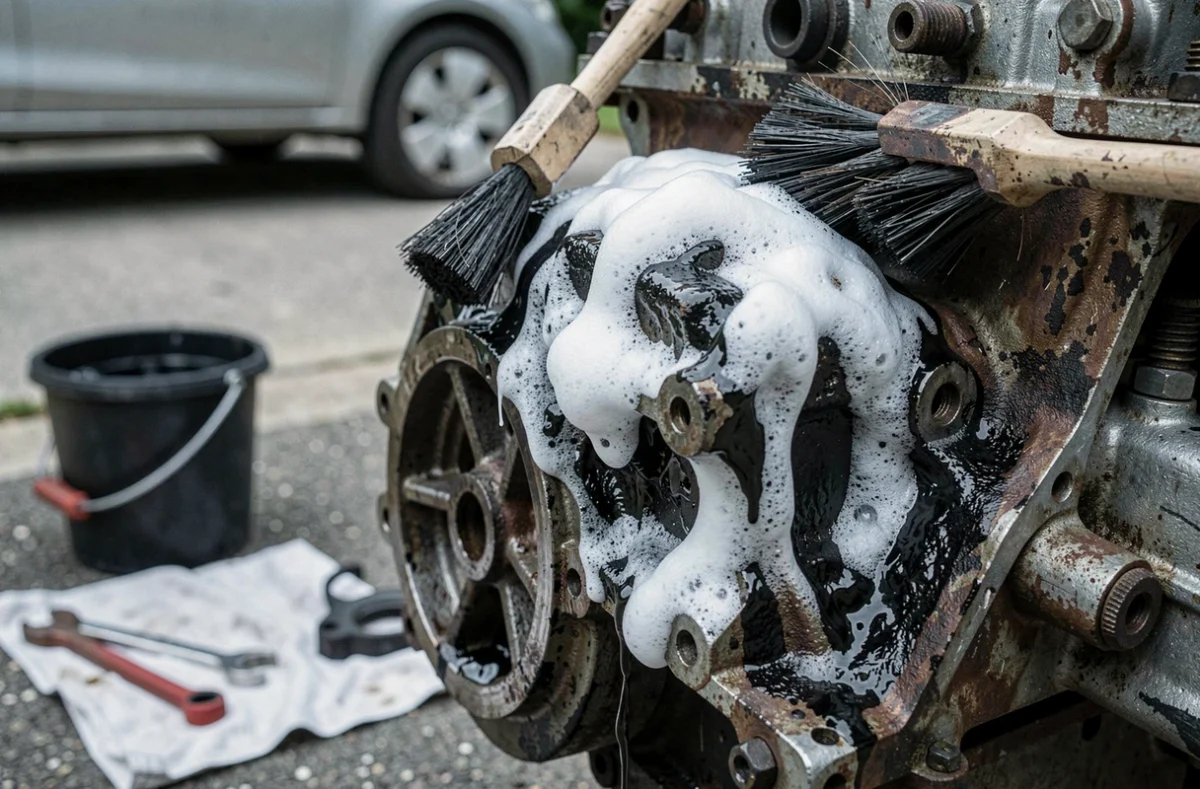
Pre-drain cleaner: when to treat and when to refrain
Internal cleaning of the lubrication circuit concerns engines whose oil has not been changed at the recommended intervals, or those that accumulate short trips in the city. The sludge that forms in the oil pan reduces oil circulation and can partially clog the oil pump strainer.
A pre-drain cleaner dissolves these deposits so that they can be evacuated with the used oil. Bardahl specifies that the product is poured into the used oil, with the engine idling, and should not remain beyond the indicated action time. Exceeding the recommended time or driving with the product in the circuit risks dislodging too many deposits and saturating the oil filter.
On a heavily soiled engine, with an uncertain maintenance history, caution dictates proceeding with two closely spaced oil changes rather than a single aggressive treatment. The oil filter should be replaced at each oil change in this case, not just at the second.
Disposal of residues: the overlooked regulatory constraint
Cleaning a soiled engine at home, in a parking lot, or in a yard generates runoff water loaded with hydrocarbons. Article L. 216-6 of the Environmental Code penalizes the discharge of harmful substances into water. Local regulations sometimes add further restrictions, especially during droughts or in catchment areas.
In practical terms, the choice of product directly influences the amount of polluted water generated. A degreaser that does not require rinsing, which is wiped with a microfiber cloth, produces no liquid effluent. A product requiring abundant rinsing necessitates either a recovery tank or the use of a professional equipped with a wastewater treatment system.
This disposal criterion deserves as much attention as the degreasing power. A very effective product that requires a liter of water per square meter of cleaned surface poses a concrete problem for an individual without suitable facilities. Prioritizing a motor cleaner that is applied with a brush and wiped off, even if it means repeating the operation, remains the simplest and most compliant solution.