This season’s women’s fashion trends are defined less by a standout color or a viral cut than by a fundamental change: materials and regulations now dictate silhouettes. The enforcement of the European ban on PFCs (perfluorinated compounds) in waterproof clothing since March 2026 is reshaping the offering of mid-season jackets and pants. Understanding these developments allows for clothing choices that are both current and sustainable.
Regenerated fabrics and bio-sourced fibers: what’s changing in women’s fashion materials
The most structuring trend of the season is not visible on a runway; it is read on labels. Regenerated fabrics made from ocean plastic waste are gaining ground in the collections of major fashion houses, according to the “State of Fashion 2026” report by McKinsey and Business of Fashion. This adoption marks a shift: sustainability is no longer a secondary marketing argument; it guides fiber choices from the design stage.
At the same time, cheap synthetic leathers have significantly declined among European designers and influencers since the beginning of the year. The “Field Testing Sustainable Materials” survey by WGSN highlights their replacement with plant-based alternatives that offer better comfort in wet conditions. A cactus or grape leather jacket does not react the same way in the rain as a PVC-based faux leather.
To closely follow these developments and find pieces aligned with these new requirements, modeusement-votre.fr regularly details the materials to prioritize season after season.
On the practical side, the European regulation 2025/2884 has banned PFCs in waterproof clothing since March 2026. Water-repellent mid-season jackets now use bio-sourced treatments. The feel changes, as does breathability. Before buying a waterproof parka or trench this season, checking for the label “PFC-free” or “bio-sourced treatment” provides a reliable indication of compliance and treatment quality.
Asymmetrical cuts and inclusive morphologies: the fashion silhouette of the season
The “Inclusive Fashion Trends 2026” study by the NPD Group highlights a phenomenon that classic style guides rarely address in depth: asymmetrical cuts are surpassing standard fluid silhouettes in terms of adoption among mature consumers and sizes 44 and up. The asymmetrical cut, by definition, breaks the symmetry of the garment (diagonal hem, offset collar, lateral layering) to create movement without adding volume.
This distinction has a direct impact on the choice of a dress or top. A straight fluid dress falls similarly on all body types, which can flatten the silhouette. An asymmetrical hem dress, on the other hand, guides the eye and visually structures the body without resorting to tight cinching.
Identifying an asymmetrical cut suitable for your body type
Not all asymmetries are created equal. Three criteria allow for a quick sorting in the fitting room or online:
- The length of the offset: a few centimeters difference between the front and back slims without dramatizing. Beyond that, the effect can unbalance smaller silhouettes.
- The break point: an asymmetry placed at the waist emphasizes the curve, while an asymmetry at the shoulder broadens the bust. Adapt the break point to the area you want to highlight.
- The fabric of the garment: a rigid fabric (gabardine, thick denim) keeps the asymmetrical line in place. A fluid fabric (viscose, crepe) creates a drape that moves with the body, more suited to dresses than structured jackets.
Spring-summer 2026 color palette: butter yellow and earthy tones
Two color families dominate wardrobes this season. Butter yellow, a warm and muted tone, stands out from bright yellow by its ability to function as a luminous neutral. Worn as a total look or as a single piece against a backdrop of earthy tones (beige, taupe, light brown), it warms the complexion without overwhelming it.
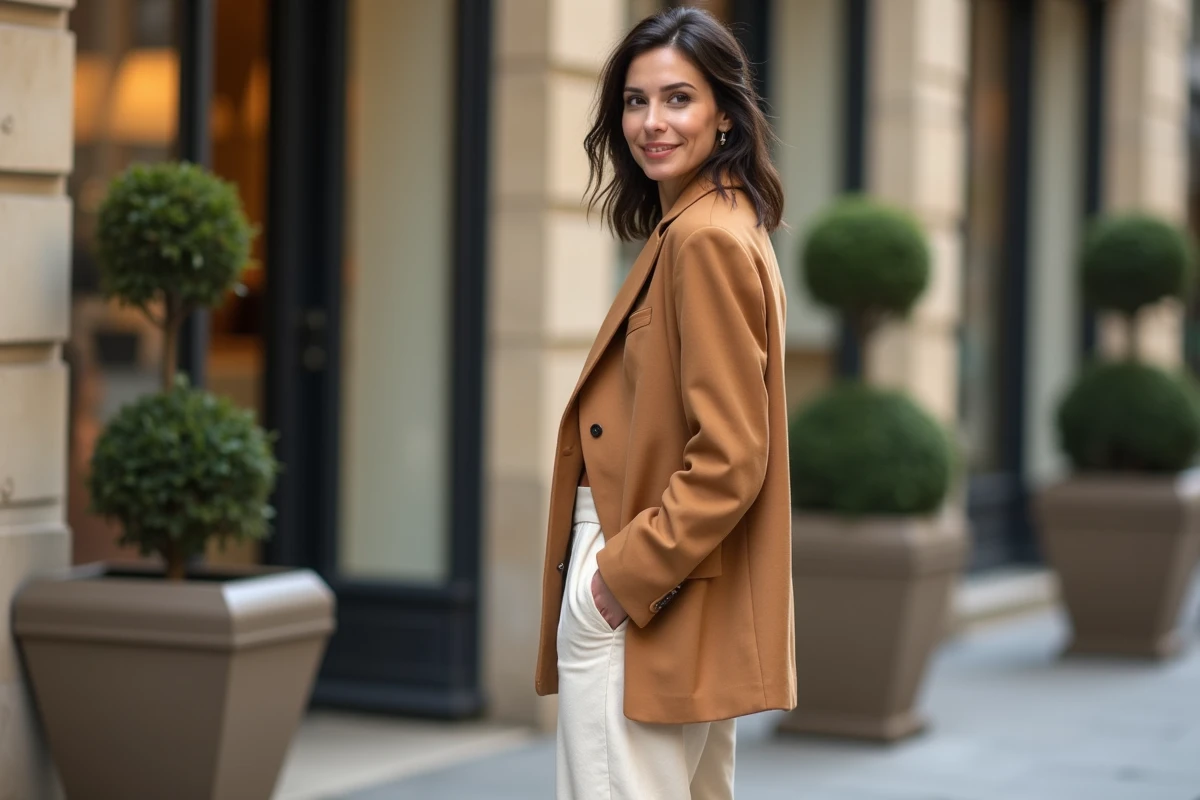
Earthy tones, in fact, form the foundation of spring-summer 2026 looks. Beige pants, colorful short jackets, and trench coats in sandy or caramel tones are returning in all selections. Their strength: these colors combine with each other without the risk of missteps, simplifying the composition of a daily outfit.
Combining colors and materials without overloading the look
A common pitfall is to accumulate trendy pieces in one look. A butter yellow top, asymmetrical pants below, statement accessories, and a jacket made of regenerated material: the whole loses clarity.
A simple rule works better: one strong piece per outfit, surrounded by neutral basics. If the top is an oversized butter yellow sweater, the bottom remains a straight jean or classic beige pants. If the strong piece is an asymmetrical jacket made of plant material, the rest of the outfit stays understated in color and cut.
Seasonal wardrobe: the pieces to prioritize
Renewing an entire wardrobe each season makes no economic or ecological sense. Three priorities allow you to capture women’s fashion trends without accumulation:
- Replace an old waterproof jacket (potentially treated with PFCs) with a model compliant with the European regulation 2026. This is a useful renewal, not an impulse purchase.
- Add a piece with an asymmetrical cut (dress, blouse, or skirt) to test the silhouette without transforming the entire wardrobe. The barrel jean, with a slightly rounded cut at the hips, pairs well with this type of top.
- Incorporate butter yellow through an accessory or a light top. The color is easy to wear from May to September and combines with most existing wardrobe basics.
The most sustainable approach remains to start from the pieces already owned and identify the gaps. A unique style is not built by copying a complete look seen online, but by adjusting details (a material, a cut, a color) to what already exists in the closet.
This season’s trends, focused on responsible materials and cuts suitable for all body types, facilitate this approach: they prioritize the quality of the garment over immediate visual impact.