
Irrigation controllers often run on batteries, exposed to the elements for months. Their power supply is rarely monitored until the day the system no longer triggers watering. The lifespan of the batteries depends less on the brand chosen than on the environment in which they operate, and especially on the condition of the metal contacts in the compartment.
The issue goes beyond the simple choice between alkaline and rechargeable batteries. An outdoor-installed controller undergoes cycles of humidity, temperature fluctuations, and corrosion risks that technical manuals rarely mention.
Corrosion of contacts by alkaline batteries: the overlooked risk for outdoor controllers
Alkaline batteries contain an electrolyte based on potassium hydroxide. When a battery ages or completely discharges in a case exposed to moisture, this electrolyte can leak. The resulting whitish deposit attacks the metal contacts of the controller, often made of standard nickel-plated steel.
In a humid outdoor environment, this phenomenon accelerates. Condensed water inside the battery compartment creates a conducive environment for galvanic corrosion between the alkaline electrolyte and the metal of the contacts. The controller then no longer receives a stable current, leading to intermittent malfunctions before complete failure.
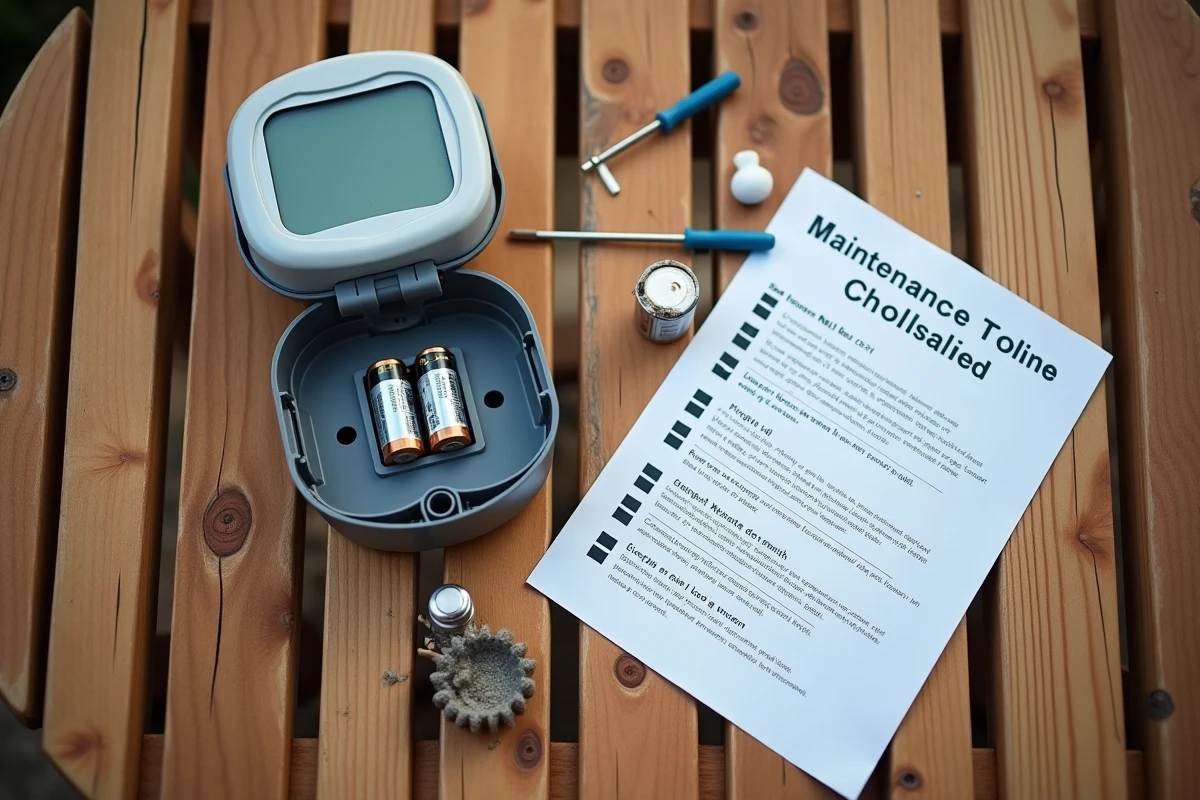
Some high-end controller manufacturers use corrosion-resistant alloy contacts (stainless steel or gold-plated) to limit this problem. On entry-level models, standard contacts degrade faster, and the cost of replacing the controller far exceeds that of regular maintenance. To delve deeper into this topic, a comprehensive guide on maintaining the controller’s batteries details preventive measures suited to each type of case.
Checking the contacts at least twice per season, at the beginning and mid-summer, allows for spotting the first signs of corrosion. A simple cleaning with abrasive rubber or diluted white vinegar is sufficient to restore conductivity, provided intervention occurs before corrosion penetrates the metal deeply.

NiMH or alkaline batteries for an irrigation controller: what tests show
The magazine Que Choisir (n°645, February 2026) published comparative tests indicating that NiMH batteries outperform alkaline ones by 25% in typical humid conditions for outdoor controllers. This result is explained by the chemistry of NiMH: their electrolyte is less corrosive in case of leakage, and their discharge voltage remains more stable over time.
Alkaline batteries have an initial advantage in nominal voltage (1.5 V compared to 1.2 V for NiMH). Some older controllers do not function properly with NiMH due to this differential. However, most recent models include a voltage regulator that accepts both types without issue.
Selection criteria based on installation
- Controller under shelter or in a buried pit: good quality alkaline batteries are suitable, provided they are replaced at least once per watering season.
- Controller fixed directly to an outdoor faucet, exposed to sun and rain: NiMH offers better resistance to thermal cycles and a reduced risk of leakage.
- Multi-way systems with solenoid valves: consumption is higher, and high-capacity NiMH (2,000 mAh or more) maintain stable power longer than alkaline batteries.
The additional cost of NiMH batteries and a charger pays off in two seasons for regular use. For a controller used a few weeks a year (second home), alkaline batteries remain a reasonable choice if removed off-season.
Temperature and storage: the impact of climate on the controller’s batteries
The French Association of Amateur Gardeners published a case study in October 2025 on users in a Mediterranean climate. Field feedback shows a 30% extension of battery life thanks to thermal insulating cases placed around the controller’s compartment.
Heat accelerates the natural self-discharge of batteries. A controller fixed to a south-facing wall can see the internal temperature of its case exceed the thresholds recommended by battery manufacturers in the height of summer. Thermal insulation (closed-cell foam, ventilated case) reduces these peaks without requiring complex intervention.
Off-season storage practices
Removing the batteries from the controller at the end of the watering season is the most effective action to prevent leaks and winter corrosion. Removed batteries should be stored in a dry place, at a stable room temperature. Keeping them in their original packaging or in a sealed bag limits contact with ambient moisture.
Never leave discharged batteries in an inactive controller: this is the primary cause of contact corrosion reported by irrigation system repairers.
European regulations on batteries: what changes for controllers
The EU regulation 2024/1670, adopted on November 15, 2024, provides for the phased-out ban on mercury and cadmium-based batteries in non-essential household devices starting July 2025. Irrigation controllers are directly affected.
This regulatory evolution pushes manufacturers to adapt their recommendations. NiCd (nickel-cadmium) batteries, still used in some older controllers, will need to be replaced with compliant alternatives. NiMH and mercury-free alkaline batteries remain permitted.
For users, the practical impact is limited: the vast majority of batteries sold in France are already compliant. The point of vigilance concerns old stocks of NiCd batteries that should be disposed of at collection points rather than continuing to use them in a controller.
- Check for the “mercury-free” or “cadmium-free” label on the packaging of new batteries.
- Return old NiCd batteries to a recycling center or collection point in stores.
- Prefer NiMH batteries for outdoor irrigation controllers, compatible with the new regulations and more durable in humid conditions.
The choice of batteries for an irrigation controller is as much about chemistry as it is about practical common sense. Cleaning the contacts, adapting the type of battery to the exposure level of the case, and systematically removing batteries off-season are three actions that, combined, prevent most failures. The European regulatory framework is moving in the same direction by eliminating the most problematic chemical compositions.