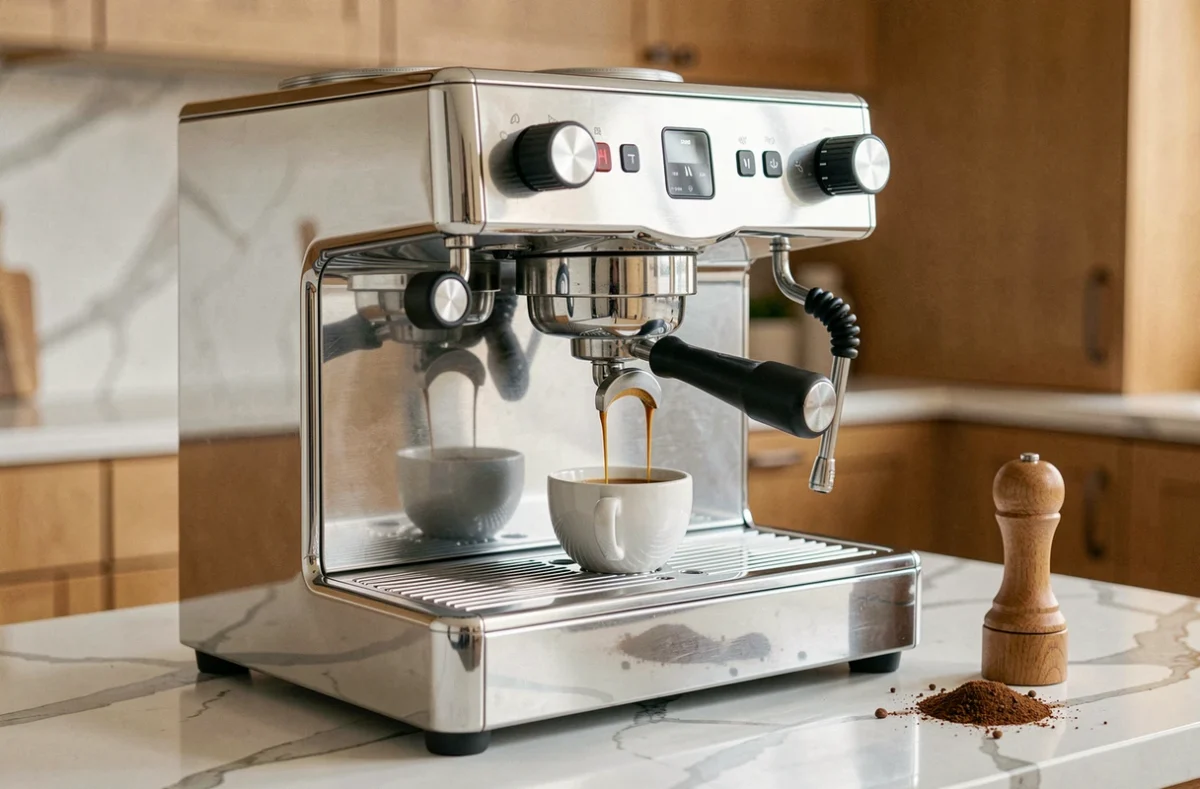
The nominal pressure displayed on the packaging of a home espresso machine says almost nothing about the quality of the espresso in your cup. What matters is the actual pressure at the coffee puck during extraction, which depends on the pump type, the hydraulic circuit and the OPV (Over Pressure Valve) setting. Understanding how this works makes it easy to rule out many unsuitable models from the outset.
Extraction pressure and pump type: what really changes the result in your cup
Almost all home machines advertise a pressure of fifteen bars. This figure refers to the pump’s maximum capacity, not the pressure applied to the ground coffee. The useful extraction pressure is around nine bars, and the over-pressure valve (OPV) regulates this parameter.
Two main types of pump are used in consumer machines. Vibratory (solenoid) pumps are the most common in entry-level and mid-range models. They are compact and inexpensive, but create pulsations in the water flow. Rotary pumps, found in semi-professional machines, deliver a steadier, quieter flow and allow more precise pressure control.
On machines with vibratory pumps, extraction consistency depends heavily on the quality of the OPV. A well-calibrated valve compensates for fluctuations. A low-quality valve allows pressure spikes that over-extract the coffee, producing bitterness and astringency. We recommend checking whether the manufacturer mentions the option to adjust or replace the OPV—a sign of a design built to last.
The product specifications available on machineaexpresso.fr make it possible to compare the hydraulic features of different models, a parameter rarely highlighted in general-purpose comparisons.
Thermoblock, single boiler or dual boiler: the impact on temperature stability
Stable water temperature is essential for consistent results, cup after cup. Three systems are available on the home market, and your choice determines the types of use the machine can handle.
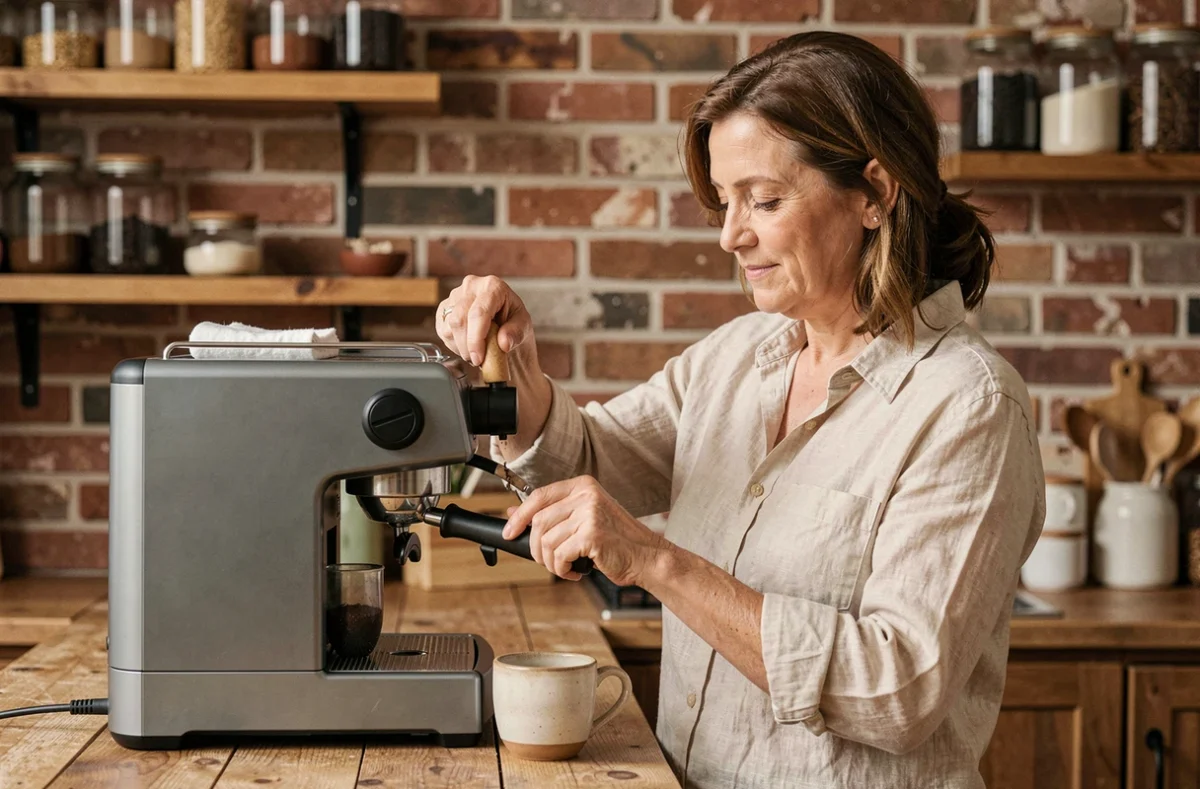
A thermoblock heats water on demand as it passes through a coil. Heat-up time is short (a few dozen seconds), but the temperature fluctuates during extraction. For straight espresso, the results are acceptable with newer thermoblocks equipped with a PID (proportional-integral-derivative controller). To switch between espresso and steam, you have to wait for the machine to purge.
A single boiler has greater thermal mass, which means better heat retention. The drawback is that it operates at only one temperature. Extraction (around 93 °C) and steam production (above 120 °C) cannot happen simultaneously. You have to wait for the temperature to rise or fall between the two operations.
A dual boiler solves this problem by dedicating one circuit to extraction and another to steam. It is the only design that lets you pull an espresso and texture milk at the same time. The extra cost is significant, but for daily use with milk-based drinks, the difference in convenience is clear.
- Thermoblock with PID: suited to drinking straight espresso, compact footprint, fast heat-up
- Single boiler: good temperature stability for extraction, but inconvenient if you switch between espresso and steam
- Dual boiler: full versatility, longer heat-up time, larger and heavier
Grind size and freshness of ground coffee: what the machine cannot fix
No machine, even a high-end one, can compensate for coffee that was ground several weeks ago. Ground coffee starts losing its aroma within minutes of being ground. That is why machines with built-in grinders and standalone grinders exist.
With a portafilter machine, choosing the grinder is just as important as choosing the machine itself. Grind size must be finely adjustable: a difference of just a few dozen microns changes the extraction time and therefore the flavour profile in the cup. Flat burr grinders produce a narrower particle-size distribution than conical burr grinders, but generate more heat at high throughput.
Automatic machines with built-in grinders simplify the process, but involve a compromise: grind settings are limited to a few steps, and the brew chamber requires a fixed dose size. The results are consistent, but less adjustable than with a standalone grinder and portafilter setup.
With capsules and pods, the grind is predetermined by the manufacturer. Users can only choose the product and, on some models, the water volume. Consistency is an advantage; customisation is a blind spot.
Repairability and lifespan: an often-overlooked factor when choosing a machine
Espresso machines are not included in the list of products covered by France’s repairability index. To assess a model’s durability, you need to check several practical points yourself.
- Availability of spare parts (group-head seals, pump, solenoid valves) and the length of time the manufacturer commits to supplying them
- Physical access to components: some machines require complex disassembly just to replace a simple O-ring
- Whether there is a network of authorised repairers or accessible technical documentation
- Whether consumables (filters, shower screens) are compatible with generic parts or only proprietary ones
A machine that can be repaired with parts available for ten years costs less than replacing a model every three years. The European Directive on the repair of goods, adopted on 13 June 2024, strengthens the general framework for the right to repair, but does not yet set specific requirements for coffee machines. It is therefore better to rely on the manufacturer’s commitments than on a regulatory framework that is still taking shape.
Ultimately, choosing an espresso machine comes down to three technical trade-offs: a heating system suited to how often you make milk-based drinks, the quality of the hydraulic circuit (pump and OPV), and how much of a coffee-grinding ritual you are willing to embrace. Investing in a good grinder alongside a mid-range portafilter machine often delivers better results in the cup than an automatic machine costing twice as much.