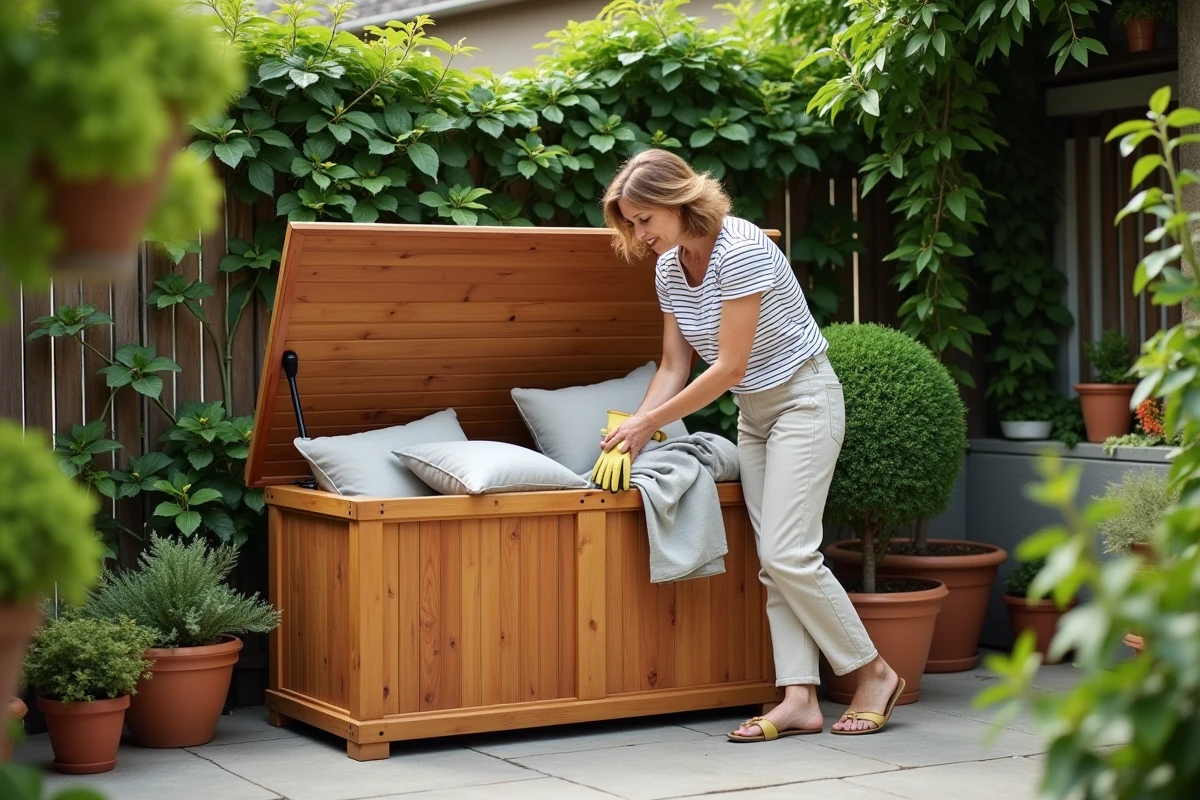
We’ve all experienced the same scenario: the lawn mower getting wet under the tarp, the living room cushions found moldy in April, the children’s toys scattered on the terrace. The garden storage box solves this outdoor storage problem, provided you don’t make a mistake on three or four technical criteria that change everything in use.
Lockable garden storage box: an insurance requirement often overlooked
Before discussing materials or capacity, let’s start with a point that most selection guides do not prioritize: the locking mechanism. If you store power tools, a bicycle, or pool equipment in your box, a locking system changes your coverage in case of theft.
Home insurers like MAIF and Groupama remind us in their practical sheets that a garden storage box with a lock, ideally anchored or backed against a wall, may be required for proper coverage in case of a claim. Without a lock, the contents stored outside may be considered insufficiently protected.
Another safety point: storing fuel (lawn mower gas, barbecue lighter fluid) in a poorly ventilated and airtight resin box is not recommended. Check for vents or ventilation grilles if you plan to store flammable products. Today, there are models with one or two low side openings that ensure minimal air circulation.
To explore the ranges available in large DIY stores, you can compare the models of Brico Dépôt garden storage boxes for outdoor storage with those offered in garden centers, the former often being positioned on generous volumes at tight prices.
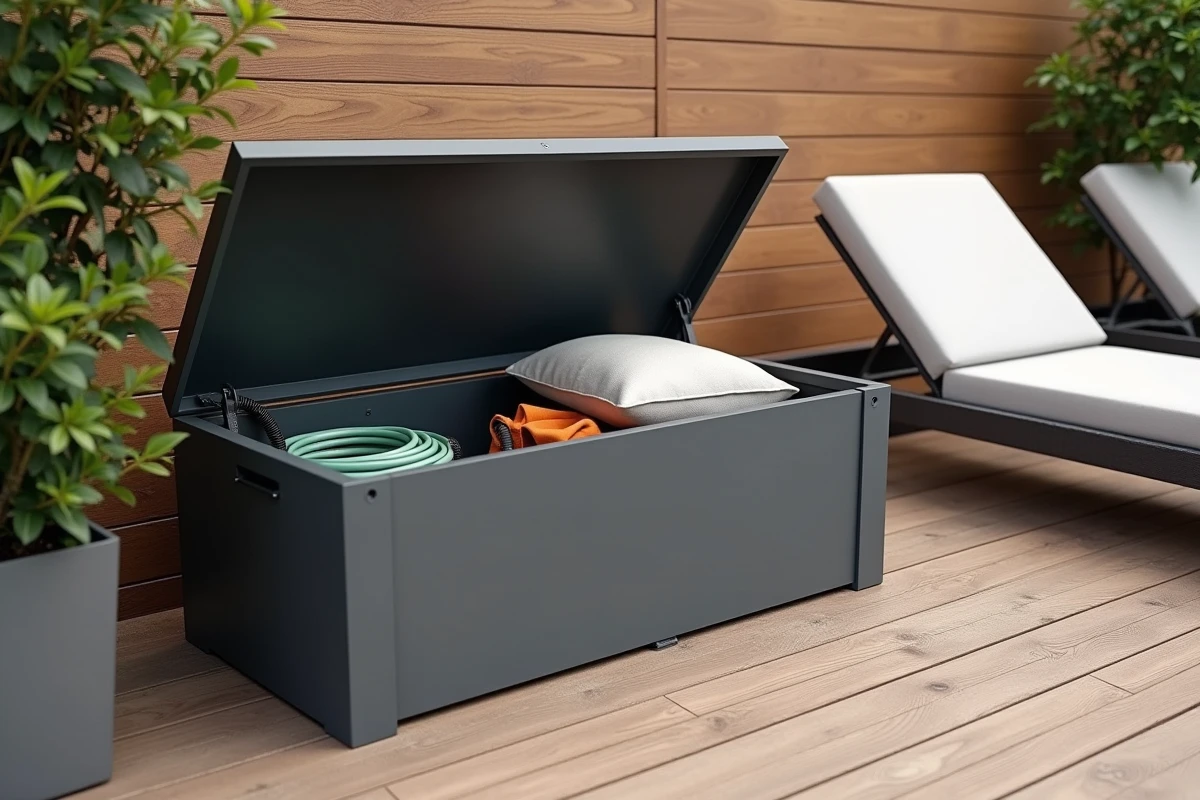
Resin, wood, or metal: which material according to your terrain constraints
The choice of material is not made from a catalog. It depends on the exact location where the box will be placed and what maintenance you are willing to accept.
Resin (polypropylene) for terrace and poolside
Resin dominates the market, and for good reason: no maintenance, weather resistance, and easy cleaning with a jet. Brands like Keter or Allibert offer resin boxes with a wood-like texture that integrate well into a garden lounge. Resin is suitable for humid areas or those exposed to splashes.
The main drawback remains UV resistance in the long term. A dark resin box exposed full south will eventually fade after a few seasons. Opt for models with UV protection mentioned on the product sheet.
Wood for a natural look (with trade-offs)
A wooden box (pressure-treated pine, acacia, teak) fits well into a landscaped garden. However, it requires a minimum annual maintenance: light sanding and application of oil or saturator. Without this treatment, the wood will gray and may crack.
If your box is placed directly on soil or grass, elevate it with pads or wedges to prevent moisture from rising by capillarity. This detail significantly extends its lifespan.
Metal (aluminum, galvanized steel) for heavy storage
Metal boxes can support heavier loads and are more resistant to attempted break-ins. They are suitable for storing heavy tools or construction equipment. The downside: internal condensation. Without insulation or ventilation, moisture forms inside and attacks the contents. Feedback on this point varies depending on the models and climates.
Garden bench box: the format that changes daily use
In recent years, outdoor furniture manufacturers have been pushing boxes designed as benches or coffee tables, with integrated backs, suitable cushions, or reinforced tops. This is not a gimmick: on a small terrace, a bench box replaces seating and frees up floor space.
The selection criteria differ from those for a classic box:
- The seat height should be within a comfortable range (comparable to that of a standard bench, around 40 to 45 cm), otherwise no one will actually sit on it
- The weight capacity when seated must be indicated by the manufacturer, which is not always the case with entry-level models
- The stability of the box once loaded and used as a seat, especially on uneven ground (tiles, gravel), deserves a test in-store
Keter, Hartman, and Allibert offer models of this type in their recent catalogs. Major garden and DIY retailers are now creating specific “bench box” sections in their selections, making comparison easier.
Volume and placement: start with what you’re storing, not what you find on the shelf
We tend to choose a garden storage box based on price or design. The reverse approach works better: list what you will store in it, then deduce the necessary volume.
- Garden lounge cushions and chair pads: plan for a generous volume, as cushions do not compress and take up more space than you might think
- Gardening tools (pruner, watering can, gloves, small tools): a compact box is sufficient, but check the depth for long handles
- Pool equipment (net, treatment products, inflatable toys): an intermediate volume is suitable, with the imperative of good ventilation if you store chemical products
- Children’s outdoor toys: an easily accessible box, with an opening that children can manipulate themselves without risk of pinching
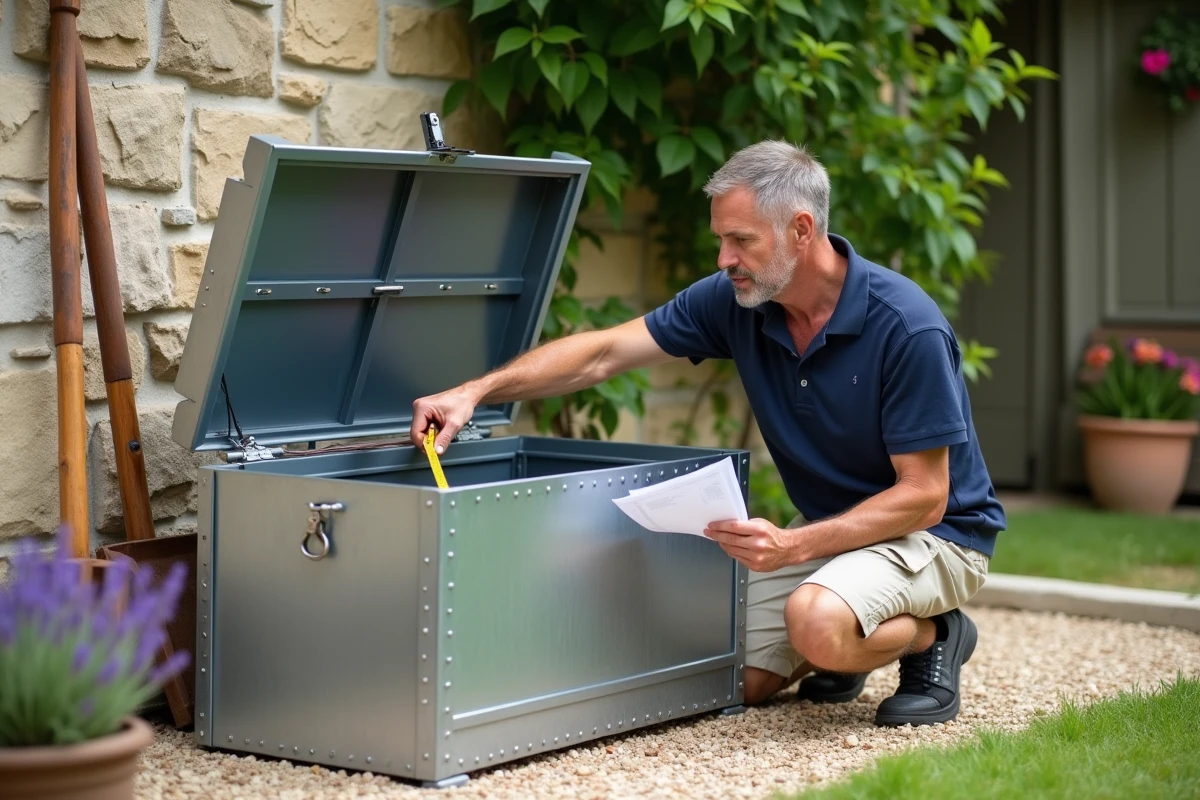
Measure the available space before buying, accounting for the space needed to open the lid. A box whose lid opens 90 degrees against a wall is useless if the space behind is insufficient. Some models offer a front or sliding opening that resolves this issue on narrow balconies.
The garden storage box may seem like a simple purchase, but a poor choice of material, locking mechanism, or volume will cost you over several seasons. Take the time to check the ventilation, type of locking, and compatibility with your home insurance: these are the three points that separate a useful box from one that you end up replacing.